
 CNEWS Reporters Wang Tso-ming and Lin You-wei / Taipei
Dementia is not an issue faced only by older adults and their families. In an aging society, recognizing the warning signs of dementia, seeking a timely diagnosis, and preparing in advance for future care and daily life are becoming increasingly important.
In observance of World Alzheimer’s Month, the Taiwan Alzheimer’s Disease Association (TADA) is holding its special exhibition, “Tomorrow’s Memorandum,” from September 18 to 21 at Building 2 of Huashan 1914 Creative Park.
Through everyday-life scenarios, interactive experiences, and personal sharing by people living with dementia, the exhibition aims to help the public better understand dementia and learn about available medical, care, financial, legal and social resources. It also highlights the abilities and possibilities that remain beyond a dementia diagnosis.
This year’s World Alzheimer’s Month message, “The Earlier You Know, The More You Can Do: A Dementia Diagnosis Matters,” emphasizes that greater awareness at an earlier stage allows people to take action sooner, while a dementia diagnosis can serve as an important gateway to treatment, care and social support.
Reflecting this message, the Taiwan Alzheimer’s Disease Association named this year’s special exhibition “Tomorrow’s Memorandum,” encouraging individuals and families to prepare together today for greater choice and autonomy tomorrow.
Taiwan Alzheimer’s Disease Association Chairman Hsu Wen-chun said that September marks World Alzheimer’s Month, when countries around the world organize various activities to raise awareness of dementia. TADA holds a special exhibition like this every year as part of World Alzheimer’s Month, giving the public opportunities to learn more about dementia and gain a better understanding of it.
This year, the event brings together healthcare professionals, legal advisers and people living with dementia. Hsu said the association hopes the public will look beyond the limitations associated with the disease and recognize that people living with dementia can still teach, host events, lead activities and apply their existing skills in ways that provide a sense of achievement and purpose.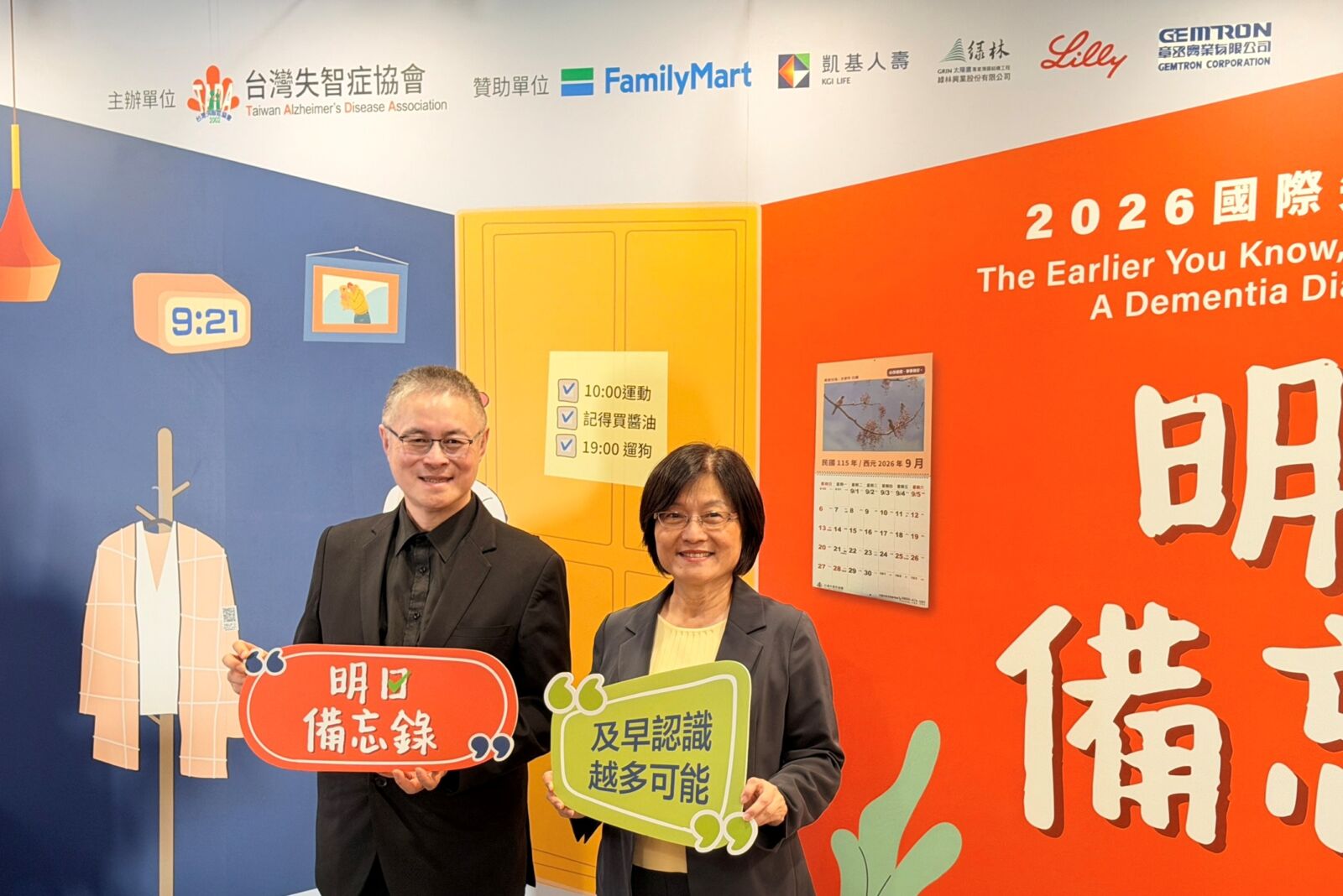
Hsu noted that the idea of “knowing earlier and having more possibilities” is not limited to dementia prevention. It also means understanding, before the disease occurs or progresses, the changes that individuals and families may eventually face.
In addition to identifying risk factors and making early lifestyle adjustments, families should gradually discuss financial planning, legal arrangements, long-term care and available social resources, he said. The more thoroughly people prepare, the greater their chances of maintaining familiar routines and preserving personal choices even after a diagnosis.
Hsu also stressed that people living with dementia should not be isolated from society. Ideally, they should be supported in remaining within familiar communities and social networks, where they can continue interacting with others.
Creating a dementia-friendly society, he said, requires not only improving physical environments and communication methods, but also helping people living with dementia adapt to changes in everyday life while encouraging broader social inclusion and understanding.
The exhibition is organized around everyday situations, including life at home, medical visits and outings. It introduces common warning signs of dementia, as well as safety measures, self-reminder strategies and medical, care and consultation resources available following a diagnosis.
Real-life examples are also used to explain the concept of supported decision-making, underscoring that dementia does not automatically mean a complete loss of ability. With appropriate assistance, people living with dementia can continue expressing their wishes, making choices and participating in everyday activities.
To demonstrate the employment potential of people with dementia, the exhibition includes a hands-on drip coffee packaging area modeled after the “Young Work Hub” developed by TADA for people with young-onset dementia.
Visitors can experience how breaking tasks into manageable steps, introducing assistive tools and redesigning job responsibilities can help people with dementia remain employed and continue making use of their skills.
The exhibition also features talks on medical care, financial planning, legal issues and caregiving. An interactive “action fortune poem” activity turns recommendations for dementia prevention and risk reduction into simple reminders that visitors can incorporate into their daily routines.
People living with dementia are also participating as lecturers and activity facilitators, sharing their personal interests, life adjustments and experiences. Visitors are invited to write a “Tomorrow’s Memorandum” addressed to their future selves, which organizers will mail back to them in 2027.
Tseng Ching-fang, a member of the association’s advisory group for people living with dementia, shared his own experience with diagnosis. After noticing that his wife had begun repeatedly asking the same questions, he accompanied her for a medical examination and decided to undergo an assessment himself. The evaluation unexpectedly revealed abnormalities in his own cognitive function.
Tseng said he was still employed when he received the diagnosis and initially hesitated to disclose his condition because he was concerned about how others might perceive him. Nevertheless, he continued working, keeping mentally active, exercising and participating in programs at a local community center. His life, he said, did not stop because of the diagnosis.
Drawing on his own experience, Tseng encouraged people who have concerns about their memory or cognitive abilities to seek professional assessment as early as possible rather than avoiding evaluation out of fear of the result.
If testing reveals no problem, people can gain reassurance, he said. If abnormalities are detected, an early diagnosis allows individuals to obtain medical advice sooner, participate in appropriate activities and build a support network, benefiting both themselves and their families.
The Taiwan Alzheimer’s Disease Association is inviting members of the public to visit the exhibition during its four-day run and take part in World Alzheimer’s Month activities. Organizers hope the event will offer visitors a closer look at the everyday experiences of families affected by dementia while encouraging greater public understanding, inclusion and support for people living with the condition.
《更多CNEWS匯流新聞網報導》
中午來開匯/嘉義市選情急了? 張啓楷獨家爆料王美惠考慮辭立委
林沛祥成功推動漁業天然災害救助修正 「單一漁港」作認定計算單位
【文章轉載請註明出處】
